
Driving and Shifting
Driving the RUSH SR is very simple. It’s doing it fast that’s going to take you a bit of practice! The clutch is only used to engage 1st gear to get going, and again when you come to a stop. You will be starting in Neutral so depress the clutch and use the left-hand paddle to shift down to first.
Remember, neutral is between first and second on a motorcycle transmission! Your selected gear is always visible on the dash.
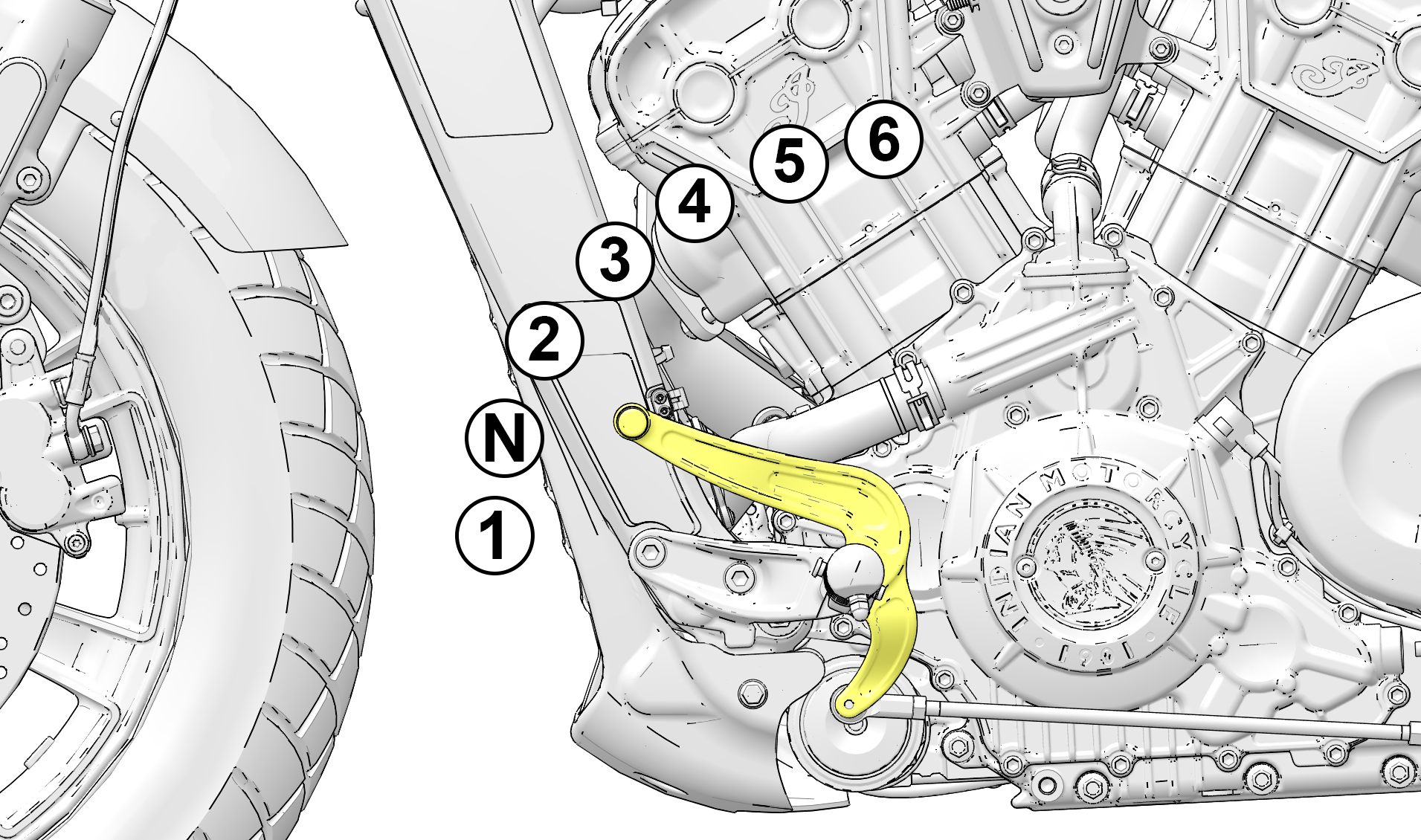
During demos we get someone to give the car a push, since most people will just stall the car. If you stall, press the clutch, press the NSel button, and upshift to neutral to allow the car to be restarted.
The car does not have a reverse gear. Plan accordingly.
Shifting
Section titled “Shifting”The Rush Auto Works GCU takes care of shifting for you, complete with blipping the throttle on downshifts, and cutting it on upshifts, so you don’t need the clutch during normal driving.
The GCU takes care of determining the correct pressure to place on the shift lever and the amount of time to cut or blip throttle. You don’t need to hold the paddle for a specific amount of time, just depress it fully and it will shift. The car will only shift once each time a paddle is pressed.
Upshifts (increasing gear) can be made with the right-hand paddle. Upshifts must be made under power, and if you lift off, it typically won’t work. The GCU will automatically cut throttle for you to unload the transmission and ensure a smooth clutchless shift.
Downshifts should be made with the left-hand paddle while off the gas. If you’re on the gas it won’t work. The GCU will automatically blip the throttle for you, so you can downshift while on the brakes, without the clutch!
1st Gear and the 2→1 False Neutral
Section titled “1st Gear and the 2→1 False Neutral”Because the Rush SR uses a motorcycle (Suzuki GSX-S1000) transmission, neutral lives between 1st and 2nd. Roughly 1% of 2→1 downshifts will settle in neutral instead of 1st — the dogs slide partway and stop in the half-position. The GCU includes a post-shift retry that catches most of these (see Shift Debugging), but the underlying mechanical risk doesn’t go away.
The problem is compounded by the ECU: the Suzuki donor ECU enforces a soft rev limit of 6,000 RPM whenever it reads gear = N. That’s stock anti-burnout behavior on the bike side and isn’t configurable. So a 2→1 false-neutral is doubly painful — you’re in the wrong gear and you can’t rev out of it. Corner exit gets bogged until the dogs engage.
To get out of a false neutral once you’re in one:
- Slow down significantly, or
- Pull the clutch to unload the gearbox so the dogs can engage cleanly into 1st.
Pedals
Section titled “Pedals”While in the paddock, perform a few brake checks to make sure you are finding the brake pedal. Wear proper shoes! We had one demo driver with large shoes manage to depress the wrong pedal!
Check Driver
Section titled “Check Driver”Before you tear the car apart looking for the missing tenths, work the cheaper checks first:
- Seat time. Most “the car is slow” problems are solved by more laps. The Rush rewards consistency over heroics.
- Tire pressures. Hot pressures off the recommended window cost real time. See Tires.
- Line and brake points. Overlay your SmartyCam clip with a quicker driver in the same car at the same track and watch where the deltas accumulate. It is almost never the straights.
- Send it. The car has more grip than you think. If your trail-brake is timid and your throttle pickup is early-and-soft, you’re leaving most of the lap on the table.
- Sack up. That fast corner you’ve been short-shifting through and lifting for? It’s flat. Probably has been all weekend.
- Honesty. If you’re consistently 2+ seconds off the pace of another driver in an identical car, the car is probably fine.
Once you’ve ruled the driver out, check dash data and Service Bulletins before pulling parts.
For shift-system troubleshooting (won’t start in neutral, compressor running constantly, manual shift attempts, shifter cylinder alignment), see Shift Debugging and Shift Harness and GCU.